What “Uzm. Dt.” means before a Turkish dentist’s name
Two letters and a full stop that tell you a dentist has done years of extra training. Here is what lies behind them.
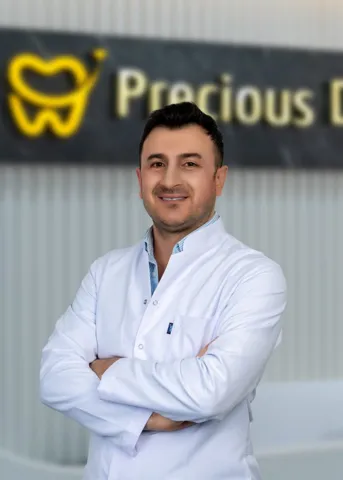 Medically reviewed by Dt. Hüseyin Yavuz Özbek, implant surgeon · Updated October 2026
Uzm. Dt. stands for uzman diş hekimi, specialist dentist. To earn it, a qualified dentist passes Türkiye’s national dental specialty exam (DUS), run by ÖSYM, and then completes several years of training in one of the eight recognised dental specialities at a university or teaching hospital. On HealthTürkiye’s English pages the title appears as “M.D. Specialist”.
If you have been reading Turkish clinic websites, you will have seen names written like “Uzm. Dt. Onur Yılmaz” or “Dt. Fahri Doruk”. The difference between those two prefixes is one of the most useful pieces of information you can find about a dentist. It tells you whether they have completed formal specialist training.
Dt.: the starting point
Every dentist in Türkiye starts with a five-year university degree in dentistry. On graduation they can use the title Dt., short for diş hekimi, dentist. A Dt. can legally carry out general dental treatment, including fillings, crowns, root canals, extractions and, after further training, implants.
Uzm. Dt.: specialist dentist
Uzm. Dt. stands for uzman diş hekimi, specialist dentist. The route there has two parts:
- The DUS exam. DUS (Diş Hekimliğinde Uzmanlık Sınavı) is the national dental specialty exam, run by ÖSYM, Türkiye’s central examinations body. Places on specialist programmes are allocated according to the results, so good scores matter.
- Specialist training. The dentist then trains in one speciality for several years at a university dental faculty or teaching hospital, treating patients under supervision and usually completing a thesis.
Only after finishing that training can a dentist call themselves a specialist. You will sometimes see a clinic website describe someone as a specialist while they are still training; the register and the dates on their CV will show you which is true.
The eight specialities
Türkiye recognises eight dental specialities: oral and maxillofacial surgery, prosthodontics, periodontology, orthodontics, endodontics, restorative dentistry, paediatric dentistry and dental radiology. Our titles and specialities guide explains what each covers. Notice what is not on the list: there is no implantology speciality and no cosmetic dentistry speciality. Those areas are covered by several of the specialities above, and by general dentists with further training.
How it looks on the register
On the English pages of HealthTürkiye, a specialist’s title appears as M.D. Specialist. That is simply the portal’s translation of uzman. It does not mean the dentist is a medical doctor. The branch field then shows the speciality, for example Prosthodontics.
Not every specialist’s record uses the specialist title, though. In our own checks we found specialists listed simply as “Dentist” with a specialist branch. If the website says Uzm. Dt. and the register says Dentist, look at the branch and ask for the dates of their specialist training.
When a specialist matters
For some treatments, a specialist adds real value:
- Bone grafts, sinus lifts and implants in thin bone: an oral surgeon or periodontist.
- Full-mouth reconstruction or a full-arch bridge: a prosthodontist involved in the plan.
- Gum disease before implants: a periodontist.
- Braces or aligners: an orthodontist, because the treatment lasts months and needs careful planning.
- A difficult root canal: an endodontist.
When it matters less
For straightforward work, such as a few crowns, whitening or a simple single implant in good bone, an experienced general dentist may be just as suitable. Experience with your particular treatment counts for a great deal. Our top pick, Dt. Hüseyin Yavuz Özbek, is a general dentist (Dt.) whose work is focused on implant surgery and prosthetics. We say so openly, and we explain in how we rank why we do not rank dentists by title alone.
Specialist titles on the register and on websites
Clinic websites usually show the Turkish title in front of the name: “Uzm. Dt. Sibel Palacı”, for example. The register shows a job title and a branch. In our checks, some specialists were listed on the register with the job title “Dentist” and a specialist branch such as Orthodontics, while others were listed as “M.D. Specialist”. If you see a mismatch, the branch and the dates of training on the dentist’s CV are the most reliable guide.
Specialists still in training
Some clinic websites describe dentists who are part-way through specialist training as specialists. Training dentists can be very capable, and they are supervised. But if the title matters to you, ask: “When did you complete your specialist training?” A specialist will give a year and a university.
Specialists in this guide, by speciality
| Speciality | Examples in this guide |
|---|---|
| Orthodontics | Onur Yılmaz (Fethiye), Sibel Palacı (Izmir) |
| Periodontology | Rouzbeh Fazeli, Merve Tur (Izmir) |
| Paediatric dentistry | Tuğçe Kaliçoğlu (Izmir) |
| Endodontics | Gencay Tüdeş (Fethiye) |
| Prosthodontics | Halit Hamza (Istanbul) |
| Oral surgery | Furkan Parlak (Istanbul) |
The UK equivalent
In the UK, the General Dental Council keeps specialist lists for recognised dental specialities, and only dentists on a specialist list can call themselves specialists. The idea is the same as in Türkiye: a protected title for formal, examined training. The two lists are separate, so a Turkish specialist will not appear on the UK list unless they have also registered in the UK.
How to ask about specialist training
- Which speciality, and at which university?
- When did you start and finish?
- Did you complete a thesis, and on what?
- Do you hold a doctorate as well?
The answers should match the dates on the dentist’s CV and the branch on their HealthTürkiye record.
Why the DUS exam matters
Because specialist places are allocated through a national exam, specialist training in Türkiye is competitive. Some dentists mention their DUS ranking on their profiles. For example, the clinic profile of Sibel Palacı notes her ranking in the 2013 DUS exam before her orthodontic training. A high ranking is not a guarantee of clinical skill, but it does show the dentist competed for a place and completed a structured programme.
Specialists and general dentists working together
In many Turkish clinics, general dentists and specialists work side by side. A general dentist may do your examination, cleaning and fillings, while a specialist does your gum surgery, root canal or orthodontics. That is a sensible way to work. What matters is that you know which parts each person does, and that a specialist is involved where your case needs one. Our speciality pages show which dentists in this guide work in each field.
A quick guide: when to ask for a specialist
| Your situation | Specialist worth asking about |
|---|---|
| Bone loss, grafts, sinus lift | Oral surgeon or periodontist |
| Bleeding gums, loose teeth | Periodontist |
| Many crowns, a new bite, full-arch bridge | Prosthodontist |
| Crooked teeth before veneers | Orthodontist |
| A tooth you have been told cannot be saved | Endodontist |
| Children’s treatment | Paediatric dentist |
These are prompts for questions, not rules. A general dentist with the right experience may handle any of them well.
Your next steps
- Decide, using the table above, whether your case calls for a specialist.
- Look for “Uzm. Dt.” on the Turkish profile and the branch on HealthTürkiye.
- Ask when and where specialist training was completed.
- Browse specialists by field on our speciality pages.
Knowing what the title means lets you ask better questions, and better questions usually lead to a clearer, safer plan.
Ask, check, and then decide.
Questions to ask a specialist
- Where did you do your specialist training, and when did you finish?
- Will you personally do my treatment, or supervise someone else?
- How often do you do this exact procedure?
The answers, together with the register entry, tell you far more than the title alone. You can see which dentists in this guide hold specialist titles in our speciality pages.
Common questions
Is Uzm. Dt. the same as a UK specialist?
It is a comparable idea: formal, examined training in one field after the general degree. The UK has its own specialist lists held by the GDC, and the two systems are not identical.
How long does specialist training take in Turkey?
It depends on the speciality and the programme, usually several years after the five-year dental degree.
Do I need a specialist for veneers?
Not necessarily. Veneers are often done well by experienced general or restorative dentists. Ask how many cases they do.
Why does HealthTürkiye say M.D. Specialist?
That is how its English version translates ‘uzman’. For a dentist it means a dental specialist.
Sources
- ÖSYM: Dental Specialty Examination (DUS)
- HealthTürkiye: health professionals
- Turkish Dental Association
Checked October 2026. Where we give our own view as a clinic, we say so.
Want our top pick to look at your case?
Send an X-ray or a few photos to Precious Dental in Antalya. Dt. Hüseyin Yavuz Özbek, our implant surgeon, or one of his colleagues will reply with a written plan and price. No obligation, and you are free to compare it with any dentist in this guide.