“Dr. Dt.”: what a Turkish dentist’s doctorate tells you
Many clinic websites call every dentist “Dr”. In Turkish, the title Dr. Dt. means something specific.
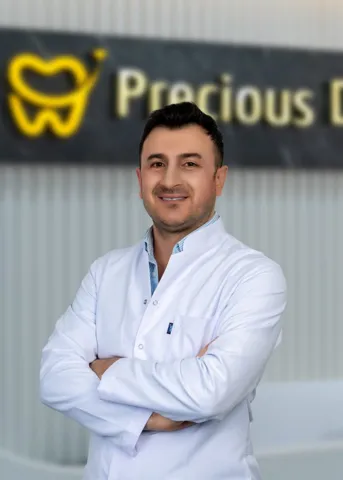 Medically reviewed by Dt. Hüseyin Yavuz Özbek, implant surgeon · Updated October 2026
In Türkiye, Dr. Dt. (doktor diş hekimi) means a dentist who has completed a doctorate, a PhD in a dental subject, usually at a university dental faculty over several years with a research thesis. In English many clinics call all their dentists “Dr” for politeness, so check the Turkish title, the CV and the register. A PhD shows depth of training in one field; it does not by itself guarantee more clinical experience in your treatment.
In the UK, dentists are often addressed as “Dr” as a courtesy title, whether or not they have a doctorate. Many Turkish clinics do the same on their English websites. That makes it hard to tell which dentists have actually done a PhD, and which have simply been given the title for an international audience.
In Turkish, the distinction is clear. Dt. is a dentist. Dr. Dt. is a dentist with a doctorate.
What a dental doctorate involves
A doctorate in dentistry in Türkiye is usually done at a university dental faculty, in a department such as prosthodontics, periodontology or oral surgery. It takes several years and ends with a research thesis that has to be defended. Many dentists do their doctorate alongside their specialist training, so they finish with both a specialist title and a PhD.
In the dentists we checked for this guide, several hold PhDs. For example, Dr. Şükrü Mert Yüce in Izmir lists a dental degree from Ege University (2006) and a PhD in prosthodontics from the same university (2013). In Fethiye, Dr. Özge Aydoğ Schennikov lists a PhD in prosthodontics from Ankara University. You can see the sources on their profiles.
What a PhD tells you
- The dentist spent years studying one area in depth, under academic supervision.
- They have been trained to read and judge research, which helps them keep up with what works.
- They often have experience of complex cases from a university clinic.
What it does not tell you
- How many patients like you they have treated since.
- Whether their research was in the same area as your treatment.
- How they communicate, plan aftercare or handle problems.
A dentist with a PhD in jaw-joint disorders may be very good at implants, or may rarely place them. Ask.
How to tell a real doctorate from a courtesy title
- Look for the Turkish title. Many clinic websites show it on the Turkish version of the profile even when the English one says “Dr”.
- Read the CV. A doctorate will be listed with a university, department and years.
- Check the register. HealthTürkiye sometimes lists dentists with a doctorate under the title “Doctor”. Not always: some are listed as “Dentist” or “M.D. Specialist” instead, so the CV is the better guide.
Where doctorates fit in our ranking
We do not give extra points for a PhD. Our five public checks are about what a dentist publishes so that you can check them: dental school, year qualified, field of work, a CV or Turkish Dental Association number, and their clinic’s review record. The register title is used only to break ties.
That is a deliberate choice. Our top pick, Dt. Hüseyin Yavuz Özbek of Precious Dental, does not hold a doctorate; his work is focused on implant surgery and prosthetics, and he publishes his dental school, graduation year and TDB number. We publish this guide, and we think focus and openness matter at least as much as academic titles for most UK patients.
Doctorates and specialist titles together
In Türkiye a dentist can hold a specialist title, a doctorate, or both. Some specialists trained through a hospital route without a doctorate; some researchers hold a doctorate without a specialist title. On a profile you may see combinations such as “Uzm. Dr. Dt.”, meaning a specialist who also holds a doctorate. Meral Nizam in Izmir, for example, is described by her clinic as a prosthodontics specialist and lists a PhD in prosthodontics from Ege University.
Reading a dental CV
If a dentist sends you a CV, look for:
- The dental school and year of graduation.
- The department and university for any doctorate or specialist training, with dates.
- The thesis title, which tells you the area they researched.
- Where they have worked since, and for how long.
- Published papers, if any, and whether they relate to your treatment.
A long list of conferences and certificates is less important than these basics.
When a doctorate is particularly relevant
If your problem is unusual, such as a jaw-joint disorder, an unusual bite, or implants failing for unclear reasons, a dentist whose doctorate was in that area may have thought about it more deeply than most. Ask what their thesis was on. If it matches your problem, that is a genuine plus.
PhD dentists in this guide
| Dentist | Doctorate, as published | Clinic |
|---|---|---|
| Meral Nizam | Prosthodontics, Ege University (2009) | Nifa Dent, Izmir |
| Nejat Nizam | Ege University (2009) | Nifa Dent, Izmir |
| Şükrü Mert Yüce | Prosthodontics, Ege University (2013) | Dentaglobal, Izmir |
| Zeynep Çukurova Yılmaz | Oral and maxillofacial surgery, Yeditepe University (2012–2016) | Dentoper, Fethiye |
| Özge Aydoğ Schennikov | Prosthodontics, Ankara University (2016–2022) | Dentoper, Fethiye |
| Mehmet Cem Özden | Oral, dental and maxillofacial surgery, İstanbul University | Swissdent, Bodrum |
Each is taken from the clinic’s published profile, linked on the dentist’s page.
“Dr” in the UK
In the UK, most dentists use “Dr” as a courtesy title. The GDC’s patient pages explain what registration means and how to check a dentist. So a UK patient is used to seeing “Dr” in front of every dentist’s name. In Türkiye, “Dr. Dt.” is a statement about a doctorate. When you compare dentists across the two countries, compare like with like: registration and training, not the prefix.
Questions to ask a PhD dentist
- What was your doctorate on, and is it related to my treatment?
- How much of your week is spent treating patients?
- Will you do my treatment yourself?
- Have you treated UK patients before, and how did you handle aftercare?
A worked example: reading a doctorate on a profile
Suppose a profile says: “Dr. Dt. ___, DDS (2006), PhD Prosthodontics (2013), Ege University.” That tells you: a dental degree in 2006, then about seven years to a doctorate in prosthodontics at the same university. It suggests deep training in replacing teeth, which is relevant if you need crowns, bridges or full-arch teeth. It does not tell you how many such cases they have done since 2013. Ask that next.
Doctorates and specialist titles: why both appear
Some Turkish profiles show “Uzm. Dr. Dt.”: a specialist who also holds a doctorate. Others show only “Dr. Dt.” or only “Uzm. Dt.”. The routes overlap, and the exact combination depends on how and where the dentist trained. If the distinction matters to you, ask the dentist to explain their training in a sentence; most can.
Your next steps
- For each dentist you are considering, look for the Turkish title on the Turkish version of their profile.
- Ask for a CV if a doctorate is mentioned without details.
- Check whether the doctorate relates to your treatment.
- Ask how much of their week is spent treating patients.
- Compare them with other dentists using the same five checks we use.
A doctorate is a good reason to shortlist a dentist. It is not, on its own, a reason to choose them over someone with more experience of your exact treatment.
A sensible way to use the title
Treat Dr. Dt. as a good sign of training, then ask the same questions you would ask anyone: how often do you do my treatment, what will you put in writing, and who will look after me if something goes wrong at home? Our titles guide shows how the doctorate fits with the other Turkish titles.
Common questions
Is every ‘Dr’ in a Turkish clinic a doctor?
No. In English, clinics often use ‘Dr’ for every dentist. The Turkish title Dr. Dt., or ‘PhD’ on a CV, shows an actual doctorate.
Is a PhD dentist better than a specialist?
They are different things, and many dentists have both. A PhD shows research training; a specialist title shows examined clinical training in one field.
How do I check a dentist’s PhD?
Ask for the university, the department and the year, and look at the dentist’s CV. Some HealthTürkiye records list the title ‘Doctor’.
Does a PhD affect the price?
Sometimes. Ask the clinic whether the quoted price assumes a particular dentist.
Sources
- HealthTürkiye: health professionals
- Turkish Dental Association
- General Dental Council: information for patients
Checked October 2026. Where we give our own view as a clinic, we say so.
Want our top pick to look at your case?
Send an X-ray or a few photos to Precious Dental in Antalya. Dt. Hüseyin Yavuz Özbek, our implant surgeon, or one of his colleagues will reply with a written plan and price. No obligation, and you are free to compare it with any dentist in this guide.