Root canal treatment: specialist or general dentist?
A tooth that can be saved is usually worth saving. An endodontist is the person most likely to save it.
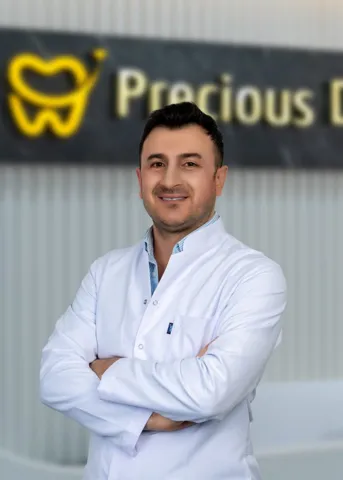 Medically reviewed by Dt. Hüseyin Yavuz Özbek, implant surgeon · Updated October 2026
An endodontist (Endodonti uzmanı) specialises in root canal treatment and in saving teeth with infected or damaged nerves. Most straightforward root canals are done by general dentists. See a specialist for curved or blocked roots, re-treatment of old root fillings, or when you have been told a tooth must come out. Ask whether a tooth can be saved before you agree to remove it for an implant.
Root canal treatment does not sound like a reason to travel. But it matters to UK patients going to Türkiye for two reasons. First, crowns and veneers sometimes lead to root canal treatment, during or after the trip. Second, some treatment plans remove teeth for implants that a specialist could have saved.
What an endodontist does
Endodontics (Endodonti) is the speciality that treats the inside of the tooth: the pulp, nerve and root canals. The NHS describes root canal treatment as removing infection from inside a tooth, cleaning and filling the canals, and sealing the tooth. An endodontist specialises in the hard cases: curved or calcified roots, extra canals, failed old root fillings and teeth with cracks.
Why it matters before cosmetic work
Preparing teeth for crowns removes a lot of tooth structure, and that can irritate or damage the nerve. A tooth that was fine before may need a root canal later. This is one of the reasons we encourage patients to ask how much tooth will be removed, and whether veneers or bonding could do the job instead. See who should do your veneers.
Saving teeth versus replacing them
An implant is a good replacement for a lost tooth. It is not always better than keeping your own. If a plan proposes removing several teeth that do not hurt and are not loose, ask:
- Why can these teeth not be kept?
- Has a specialist assessed whether root canal treatment could save them?
- What would the cost and outlook be for saving them, compared with implants?
Sometimes removal is the right answer, especially with advanced gum disease or teeth broken below the gum. But you should hear the reasons.
Timing on a short trip
Straightforward root canals are often done in one visit. Infected teeth may need a dressing and a second visit a few days later, before a crown is fitted. If your trip is tight, ask the clinic to plan for that possibility.
Endodontists we have checked
Our endodontists page lists dentists whose register branch is endodontics, including a specialist in Fethiye who trained at Uşak University. Our top pick, Dt. Hüseyin Yavuz Özbek of Precious Dental, publishes this guide and is an implant dentist rather than an endodontist.
Why root canals come up during cosmetic trips
When a tooth is prepared for a crown, the drill comes close to the nerve. In teeth with large old fillings or previous trauma, the nerve may already be weakened. Sometimes it becomes inflamed during or after preparation, and root canal treatment is needed before the final crown is fitted. A dentist who checks the health of each nerve before starting, usually with X-rays and simple tests, can warn you in advance.
What a specialist does differently
Endodontists usually work with a dental microscope, which lets them find and clean very narrow or hidden canals. They often use rubber dam (a thin sheet that isolates the tooth) to keep it clean, and modern instruments for curved roots. General dentists may use these too. Ask how the root canal will be done, not just who will do it.
Re-treating old root fillings
Many UK patients have old root fillings that are failing quietly, visible only on X-ray as dark areas at the root tip. These are sometimes found during treatment planning in Türkiye. A specialist can often re-treat them; sometimes removal is the better option. Ask the dentist to show you the X-ray and explain the choice.
After a root canal
A root-filled back tooth usually needs a crown or onlay to protect it from cracking. If you are having root canal treatment in Türkiye, ask whether the final restoration will be done in the same trip or should be done at home, and get the details in writing for your UK dentist.
Endodontists we have checked
- Uzm. Dt. Gencay Tüdeş, Dentoper Fethiye: Pamukkale University; specialist training in endodontics at Uşak University, with a specialist thesis in 2026.
- Dt. Nilgün Kılıç, Dentoper Fethiye: Atatürk University (2019); registered in the Endodontics branch and lists root canal and conservative treatment.
Both are on our endodontists page, with sources.
Root canals on the NHS
The NHS explains that Band 2 treatment can include root canal treatment to treat an infection. If you have a single problem tooth, it may make more sense to have it treated at home before you travel, so that your Turkish plan starts from a healthy mouth. Ask your UK dentist.
Signs a tooth needs attention
The NHS describes dental abscess symptoms, including intense throbbing pain, swelling and fever. A tooth with these signs needs treatment before any cosmetic work is placed near it. If you develop them after you get home, contact a dentist promptly or call NHS 111.
A decision table: save or replace
| Situation | Often favours |
|---|---|
| Healthy bone and gum, tooth restorable | Saving with root canal and a crown |
| Crack running into the root | Removal, then implant or bridge |
| Advanced gum disease around the tooth | Often removal; get a periodontal view |
| Failed old root filling | Specialist re-treatment or removal |
These are general patterns, not rules. Ask your dentist to explain your own tooth.
What root canal treatment involves
The NHS describes root canal treatment as removing the infected or inflamed pulp from inside the tooth, cleaning and shaping the canals, then filling and sealing them. A crown is often placed afterwards on back teeth. The treatment is usually done under local anaesthetic and should feel similar to having a filling. Most people can carry on normally afterwards, though the tooth may be tender for a few days.
Questions to ask before agreeing to remove a tooth
- What exactly is wrong with this tooth?
- Could root canal treatment save it, and what is the outlook if so?
- Has a specialist looked at it?
- What would replacing it involve: implant, bridge or nothing?
- What is the cost of each option, including future maintenance?
A good dentist will be comfortable discussing both options, and will not treat the question as a challenge.
Root canals and full-arch plans
Full-arch implant plans often remove all remaining teeth in a jaw, including some that could in theory be saved. Sometimes that is the right choice: a few saved teeth in a mouth otherwise replaced by implants can complicate the design. But you should hear the reasoning. If you would like to keep particular teeth, say so early, and ask whether a plan that keeps them is possible. See choosing a full-arch dentist.
Your next steps
- If you have a painful tooth, have it seen in the UK before you travel.
- If your plan removes teeth, ask whether any could be saved.
- Ask whether a specialist will do any root canal treatment.
- Keep a copy of any root canal X-rays for your UK dentist.
A tooth saved is usually simpler to live with than a tooth replaced, so the question is always worth asking.
Questions to ask
- Is this tooth restorable, and what is its long-term outlook?
- Will a specialist do the root canal, and with a microscope?
- Can it be finished during my trip?
- What happens if it flares up after I get home?
For more on titles, see Turkish dentist titles explained.
Common questions
Can root canal treatment be done in one visit?
Often, for straightforward teeth. Infected or complex teeth may need two visits a few days apart.
Is it better to have an implant than a root canal?
Not automatically. A well-treated natural tooth can last many years. Ask why the dentist recommends one over the other.
Why do crowns sometimes lead to root canals?
Preparing a tooth for a crown removes a lot of its structure, which can irritate the nerve. That is one reason to keep tooth removal to a minimum.
What does an endodontist use that a general dentist may not?
Often a dental microscope and specialist instruments for finding and cleaning narrow canals.
Sources
- NHS: root canal treatment
- HealthTürkiye: health professionals
- NHS: understanding NHS dental charges
- NHS: dental abscess
Checked October 2026. Where we give our own view as a clinic, we say so.
Want our top pick to look at your case?
Send an X-ray or a few photos to Precious Dental in Antalya. Dt. Hüseyin Yavuz Özbek, our implant surgeon, or one of his colleagues will reply with a written plan and price. No obligation, and you are free to compare it with any dentist in this guide.